


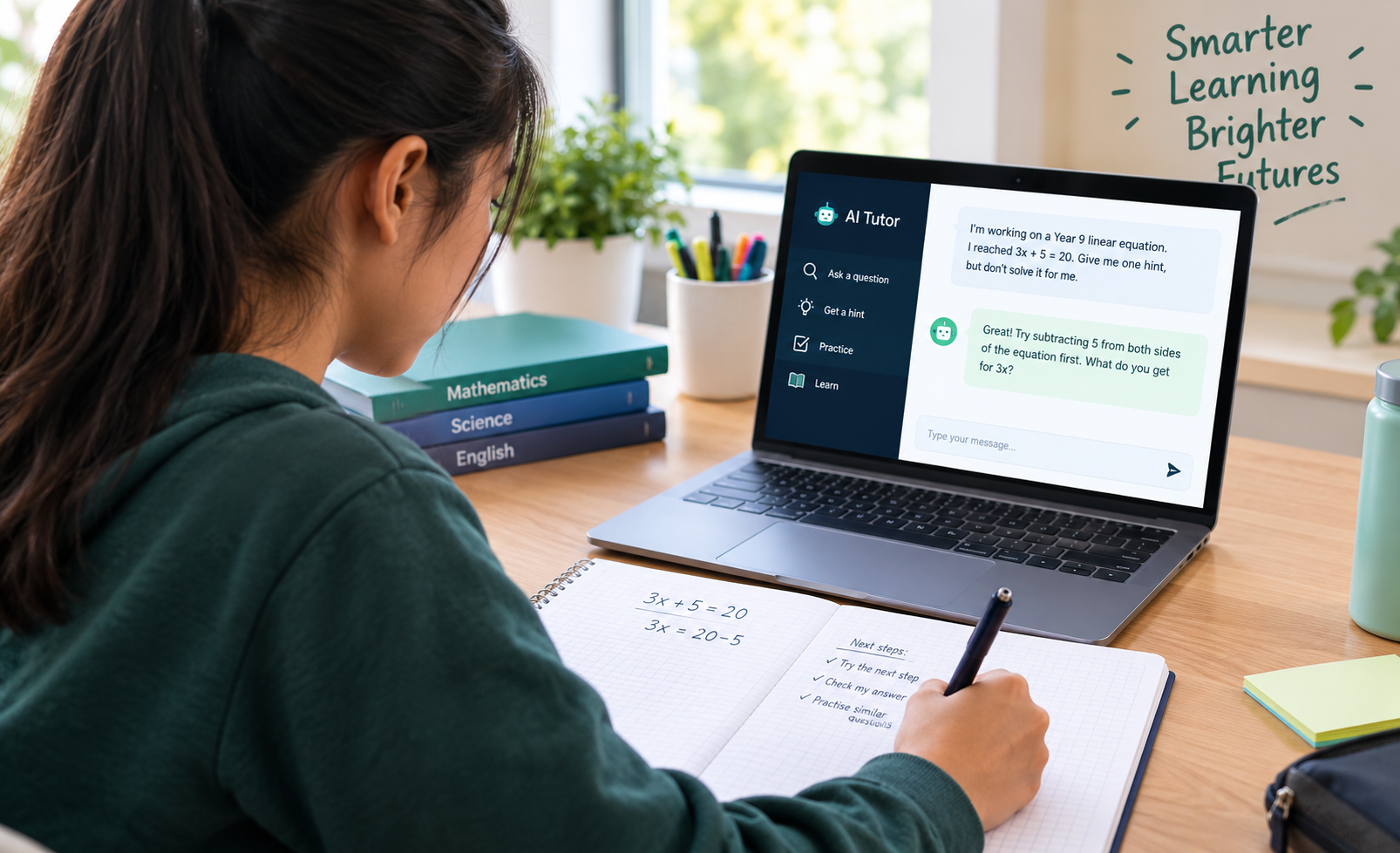
Have you ever understood a lesson in class, then felt stuck when you sat down to do the homework? You are not alone. Sometimes you need to hear an idea explained in a different way or practise one more example before it clicks. AI can help with that, provided you remain the one doing the learning.
The most useful question to ask AI is often not “What’s the answer?” It is “What should I try next?”
Start with your own attempt
Before opening an AI tool, read the question carefully and write down what you know. Try the first step, even if you are unsure. This gives you something specific to ask about and helps you see where the difficulty begins.
Suppose you are solving 3x + 5 = 20. You could type:
“I’m working on a Year 9 linear equation. I reached 3x + 5 = 20. Give me one hint, but don’t solve it for me.”
Use the hint to try the next step yourself. If you are still stuck, explain what you tried and ask for another clue. This works much like putting your hand up in class: the aim is to move your thinking forward.
Turn explanations into practice
An explanation may feel clear while you are reading it. The real test is whether you can use the idea on a new question. After AI explains a topic, ask it for three practice questions, one at a time. Answer each before seeing the solution.
If you make a mistake, ask where your reasoning first went wrong. Correct it and try a similar question. Then close the chat and explain the method aloud or on paper in your own words. If you cannot explain it yet, return to the part that confused you.
Check the answer and know the rules
AI sometimes gives an incorrect answer with great confidence. Check calculations and important facts against your class notes, textbook or a reliable source. If a step does not make sense, ask your teacher or tutor.
Follow your school’s rules for using AI, particularly in assessments. If you are expected to complete work independently, do so. A polished answer you cannot explain will not help you in the next lesson or test. Avoid entering personal information about yourself or others into an AI tool and use age-appropriate tools permitted by your school.
A prompt to try
“Act as a patient tutor. First ask what I have tried. Give me one hint at a time and wait for my response. Check that I understand each step. Do not give me the final answer unless I ask after making an attempt.”
AI can offer another explanation, extra practice and immediate feedback. You still need to make the decisions, check the result and show what you understand.
At Tuition Zone, we want students to leave a session able to tackle the next question themselves. That is the best way to use AI, too: keep your hands on the wheel.
Featured image alt text: Secondary student works through a problem in a notebook with a laptop beside them for study support.
Suggested excerpt: AI can be a useful study partner when it gives hints, practice and feedback. Here’s how students can use it to build understanding while doing their own thinking.